

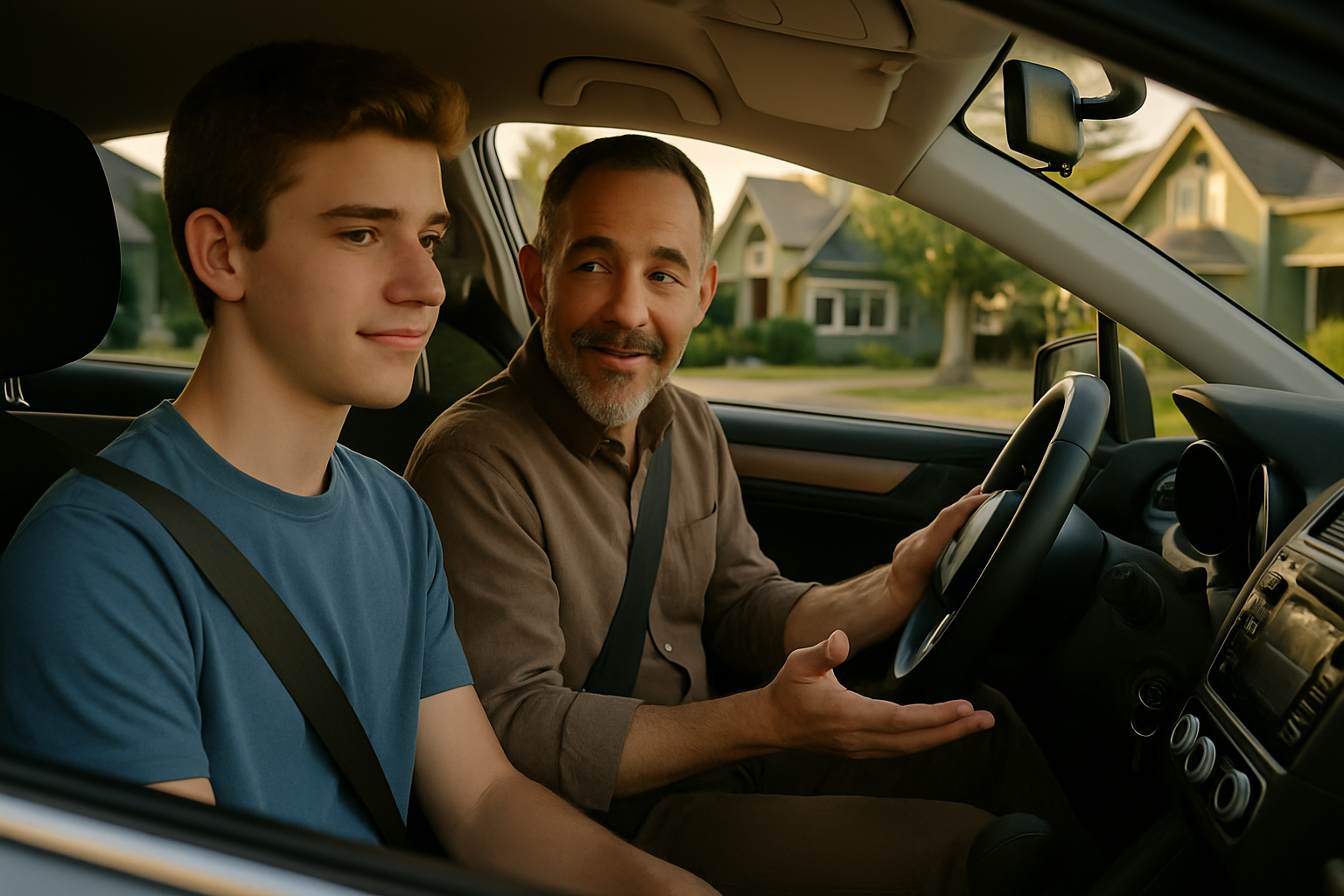
Parent-supervised driving practice using ODOT-approved techniques from Portland driving school programs.
Portland Driving School: 7 Reasons Teaching My Teen to Drive Feels Impossible
If you learned to drive in the 1980s or 1990s, teaching your teen feels harder now. As an experienced Portland driving school instructor, I hear this from parents every week: “Why is it so hard for me to train my kids how to drive?” The honest answer? Your Portland driving school uses modern methods that didn’t exist when you learned.
Back then, most of us were taught a pretty simple formula:
- Most of us were born with a steering wheel in our hand – from toys to bikes to old cars in the field for practice.
- Memorize the rules of the road.
- Watch a few scary crash films.
- Be aware of everything around you at all times.
- Learn how not to hit the curb when you parallel park.
- Pass the test and you’re done.
Fast-forward 40 years, and your teen is learning from a completely different, nationally respected modern playbook used by every professional Portland driving school. In Oregon, state data shows that the huge majority of teen crashes involve drivers who never took an ODOT-approved driver education course. Teens who complete a quality program at a certified Portland driving school are only a small slice of the licensed teen population, yet they’re involved in under 10% of the crashes.
It’s pretty much a no-brainer. Not to mention the insurance discounts. Insurance companies are still making a killing with odds like that in favor of students from an ODOT-approved Portland driving school – and as parents, we get the real payoff: our kids coming home every night.
📋 Table of Contents
- → A Story Every Portland Driving School Instructor Remembers
- → Why Old Driving Habits Don’t Match Today’s Portland Driving School Methods
- → What Driver Training Looked Like 40 Years Ago
- → How Today’s Portland Driving School Uses ODOT Playbook R3
- → 7 Ways to Support Your Teen Using Modern Methods
- → How Our Portland Driving School 10-Lesson System Works
- → Bottom Line: Partner with a Portland Driving School
A Story Every Portland Driving School Instructor Never Forgets
That hole in your heart you’d never be able to fill? Driver Ed at a professional Portland driving school is one of the few tools we have that can help prevent it.
We had an instructor, Steve, who lost his daughter at 16. She was the only one on the road, the only one in the car. It was a cell phone. Steve never got to say goodbye.
He used to hold up her picture at orientation. Everyone would cry as he told the story. Fast forward about 15 years. My son and I took Steve fishing. As we got within about 200 yards of the spot, Steve said, “Guys, stop the car. I need to tell you something.”
He told us he had taught his daughter to fish and, after she died, he let everything rot. He had a beautiful fishing boat that he just left outside to rot. He said, “I just want you to know how much this means to me. I haven’t been fishing since my daughter passed away.”
That day, Steve caught six fish, including a jack salmon.
The reason he is a driving instructor is therapy. His students are… “No tickets, no accidents.” He loved every single one of them. This is why every Portland driving school takes safety so seriously.
This isn’t about passing a test. We should just call it: “make-it-home-alive”.

Why Your Old Driving Habits Don’t Match Today’s Portland Driving School Expectations
In Oregon, modern curriculum used by every certified Portland driving school like the Oregon Risk Prevention Curriculum – Playbook R3 focuses on risk management, space management, vision habits, and brain development, not just basic car control.
So when parents tell me, “Why is it so hard for me to train my kids how to drive?” the honest answer is:
You’re trying to teach today’s expectations with yesterday’s methods – while your teen’s Portland driving school uses cutting-edge techniques.
Let’s look at how driver training 40 years ago compares to what your teen learns at a modern Portland driving school today – and what you, as a parent, can do to help them practice using current standards recommended by the Oregon Department of Transportation.
First, stop with the 10 and 2 hand position – every Portland driving school now teaches 8 and 4.
What Driver Training Looked Like 40 Years Ago (Before Modern Portland Driving School Standards)
If you learned to drive in the late 70s, 80s, or early 90s before modern Portland driving school methods existed, getting up to speed looked something like this:
Today’s Portland Driving School Methods vs Old Way:
- (old way) 10-and-2 hand position on the wheel → (today every Portland driving school teaches 8-and-4)
- (old way) Hand-over-hand steering for every turn → (today we mostly use push-pull on the road)
- (old way) Hard braking in a straight line → (today Portland driving school instructors teach target tracking and trail braking)
- (old way) Parallel parking as the “big exam skill” → (modern methods use reference points and backup cameras)
The main question back then was simple: Can you control the car and stay in your lane?
There was much less emphasis on what every modern Portland driving school now prioritizes:
- Risk factors (fatigue, distraction, peer pressure).
- Teen brain development and impulse control.
- Graduated driver licensing and teen-specific crash patterns.
Parents Can’t Teach “The Way They Were Taught” to Portland Driving School Standards
Parents usually filled in the gaps with informal lessons like:
- “Just keep it between the lines.”
- “If you can merge, you’re fine. Go, go, go.”
- “Watch me and follow what I do.”
It wasn’t wrong for that era – but it’s not enough for today’s roads, traffic, and the standards your teen learns at their Portland driving school.
How Today’s Portland Driving School Uses ODOT Playbook R3 Methods
In Oregon, every certified Portland driving school follows the Playbook R3 and the How to Guide Your Teen Driver parent manual. These are built around risk prevention and habit-building, not just “car control.” The curriculum is centered around commentary driving (give the instructions AHEAD of time) and modern techniques that work.
The real question now is:
Can the parent or Portland driving school instructor give directions ahead of time – and can the teen see, think, decide, and communicate early enough to stay out of trouble?
1. Vision and Space Management First (Portland Driving School Priority #1)
Modern curriculum emphasizes how your teen uses their eyes and space, including:
- Target / Target Area – where they’re looking far ahead, not just over the hood.
- Central, fringe, and peripheral vision – and how each one is used to find problems early.
- Blind spot checks and proper mirror use taught at every Portland driving school.
- Lane Positions 1–5 – not just “stay centered,” but intentional lane placement to manage risk.
This lines up with the Playbook R3 chapters on Vision Control, Steering Control, Space Management, and Interacting with Traffic that your teen’s Portland driving school follows exactly. For more details on Oregon’s driver education standards, visit the National Highway Traffic Safety Administration teen driving resources.
2. Modern Steering and Braking Habits Every Portland Driving School Teaches
Instead of just “don’t cross your arms,” your teen’s Portland driving school instructor teaches:
- Hand position at 9-and-3 or 8-and-4 (I like 8-and-4).
- Reference points – like the underside of the mirrors, or where the hood lines up with curb.
- Push-pull steering on the road vs. hand-over-hand only in the parking lot.
- Trail braking – gently easing off the brake through a turn for better control.
- Covering the brake and using inching speed in high-risk areas.
These are fine-tuned control habits that either didn’t exist or weren’t emphasized in 1980s curriculum. Today every professional Portland driving school instructor teaches these as standard practice.
3. Reference Points and Transition Pegs (Core Portland Driving School Technique)
Instead of “feel it out,” every Portland driving school now uses:
- Reference Points – specific spots on the car that line up with center lines, pulling up to curbs, and crosswalks.
- Transition Pegs – visual markers that tell the driver when to start steering or adjusting speed.
This makes driving teachable and repeatable at your teen’s Portland driving school, instead of “just follow what I do.”
4. Risk, Brain Development, and Graduated Licensing (Portland Driving School Focus)
Modern guides used by every Portland driving school, including Oregon’s parent handbook, explicitly teach parents about:
- Teen brain development (the decision-making part is still maturing).
- How risk-taking and peer influence affect driving.
- Graduated Driver Licensing (GDL) restrictions.
- Why teens who complete ODOT-approved Portland driving school programs have lower crash rates.
When you feel like “This isn’t how I learned at all” — you’re right. Your teen’s Portland driving school uses very different expectations now. To learn more about our teen driver education program, visit our dedicated teens page.
7 Ways to Support Your Teen Using Modern Portland Driving School Methods
So here’s the real question: What is the easiest way to teach our youth to drive while supporting what they learn at their Portland driving school?
A few simple steps will align your home practice with what your teen is learning at their Portland driving school.
First tip: stop rubber-necking.
It makes the student nervous when you’re whipping your head around more than they are.
Second tip: get a second mirror.
Amazon has some great very clear baby mirrors that clip on the sun visor so you can see what’s behind you without twisting like a pretzel.
1. Skim the Same Materials Your Portland Driving School Uses
- Review Oregon’s How to Guide Your Teen Driver (DMV Form 7190). It’s actually a super easy read. It mirrors the skills your teen is practicing at their Portland driving school.
- ODOT-approved teen programs will show you exactly which Playbook R3 chapters they’re covering that week. That means you can easily be one step ahead of what your teen learns at their Portland driving school.
Even a 10-minute skim puts you on the same page vocabulary-wise with your teen’s Portland driving school instructor.
2. Use L-S-M-I-L-E at the Start of Every Drive (Portland Driving School Standard)
Make LSMILE your family rule. Every Portland driving school teaches this. This will actually keep harmony in your household.
Do not move the car until your teen can walk around it and run through L-S-M-I-L-E out loud:
- L – Look and lock
Is the area around the car clear? This one habit builds harmony and is taught at every Portland driving school. - S – Seat, steering wheel, safety belt
Seat adjusted (hips back, good pedal reach), steering wheel distance, head restraint, belt snug. - M – Mirrors
Side and rear view mirrors adjusted to shrink blind spots and support peripheral vision. - I – Ignition
Start the car, check gauges and warning lights. - L – Lights
Headlights on (even during the day for visibility), signals working if needed. - E – Emergency brake
Confirm it’s set before starting and properly released before driving.
LSMILE is worth 5 points on any drive test and taught at every Portland driving school.
3. Use M-S-M-O-G for Every Lane Change (Portland Driving School Technique)
Instead of saying, “Just go, it’s clear,” coach the steps your teen’s Portland driving school teaches:
“Mirror, signal, side mirror, over-shoulder, go when clear.”
- M – Mirror (rearview and side mirror)
- S – Signal (turn the signal on and leave it on)
- M – Mirror again (see how others are reacting)
- O – Over-shoulder (blind spot check)
- G – Go when clear (smooth lane change)
Over time, this becomes automatic and lines up exactly with what their Portland driving school instructor expects. For more details about our approach, learn about our certified instructors.
4. Start in a Quiet Parking Lot (Every Portland Driving School Starts Here)
Every professional Portland driving school starts students in a quiet parking lot first.
Do L-S-M-I-L-E first. Then focus on:
- Driving on target (picking a target and holding a straight path).
- Learning 4 reference points your teen’s Portland driving school teaches.
- Blind spot checks (chin to shoulder before moving sideways).
- Get the feel of the car. Do four 30-minute sessions like this. No rush.
5. Know When to Hand Things Off to the Portland Driving School Pros
It’s completely okay to say:
- “I’m nervous over 40 miles per hour – let your Portland driving school instructor handle that first.”
- “Freeways make me nervous. I want your Portland driving school to take the lead there first.”
- “Let’s let the Portland driving school introduce trail braking and complex curves, then we’ll practice it together.”
Your job isn’t to be perfect – it’s to be consistent, supportive, and aligned with what your teen’s Portland driving school teaches. Check our current class schedule to see available training times.
6. Log Hours Like It Actually Matters (Portland Driving School Requirement)
In Oregon, the requirement for teens enrolled in a Portland driving school is:
- 50 hours of supervised practice with an ODOT-approved Portland driving school course.
- 100 hours without driver ed.
Use a driving log and note:
- Date, time, and conditions (day/night, rain, freeway/city).
- Skills practiced (lane changes, parking, hills, intersections, freeways, night driving).
7. Practice What Your Portland Driving School Teaches Each Week
Ask your teen’s Portland driving school instructor: “What are 3 things we can practice this week at home?”
This keeps your practice aligned with what they’re learning at their Portland driving school.
How Our Portland Driving School 10-Lesson System Helps You Know What to Practice
At 1st Learn To Drive, our Portland driving school instructor drive sheets for each route are basically a practice Lesson Plan you can borrow at home. Each 30-minute drive targets specific skills your teen needs.
Here’s how the 10 drives flow at our Portland driving school, and what that means for your home practice:
- Drive 1 – Uniting Driver and Vehicle: Basic controls, smooth starts and stops, targets, and reference points. (Your home version: L-S-M-I-L-E, smooth gas/brake, targets in a parking lot.)
- Drive 2 – Knowing Where You Are: Reference points, precision right/left turns, angle parking. (Your home version: practice lane position, where the car sits at curb and stop lines.)
- Drive 3 – You Are in Control: Tracking and targeting path, backing, 3-point turns, U-turns. (Home: quiet neighborhood turnarounds and backing.)
- Drive 4 – Find, Solve, Control: Angle parking, hill parking, following distance. (Home: counting following distance, parking on hills correctly.)
- Drive 5 – You Control the Intersection: Staggered stops, legal vs safety stop, roundabouts. (Home: left-left-right-left scan pattern.)
- Drive 6 – Space Management: Timing side zones, ped/bike rules, curves and hills. (Home: moving lane position to create space.)
- Drive 7 – The Science of Driving: Traction, curves, hills, right-of-way, commentary driving. (Home: have your teen “talk out loud” about what they see coming.)
- Drive 8 – Creating Open Spaces: Hill stops/starts, parallel parking, timing side zones at higher speeds. (Home: calm, repeatable parallel parking.)
- Drive 9 – Night Vehicle Readiness: Night checks, headlight use, glare control, emergency procedures. (Home: early supervised night drives in simple areas.)
- Drive 10 – Putting It All Together: Freeway entry/exit, limited access highways, lane changes with full zone control. (Home: only after they’re solid in town.)
When you look at it this way, your practice plan aligns perfectly with what your teen’s Portland driving school teaches. Each week, just ask:
“Which drive are they on at their Portland driving school, and what is one piece of that I can help them practice this week?”
That’s it. That’s the whole secret to supporting what your teen’s Portland driving school instructor teaches.
Bottom Line: Partner with a Professional Portland Driving School
If you feel like teaching your teen to drive is harder than it was for your parents, you’re right. The roads are busier, the distractions are worse, and the expectations are higher – which is exactly why choosing the right Portland driving school matters so much.
But you’re not alone in this. Between ODOT’s Playbook R3, the state’s How to Guide Your Teen Driver, and a solid Portland driving school backing you up, you don’t have to reinvent anything. You just have to plug into the system.
Your teen brings the courage. Your Portland driving school brings the curriculum. You bring the time and love.
Together, that’s how we all make it home safe.
Ready to get started with a trusted Portland driving school? Contact us today to discuss your teen’s needs and schedule their first professional lesson with our ODOT-approved instructors.
1st Learn To Drive – Portland’s most trusted Portland driving school for excellent teen driver education with proven results. Proudly serving Portland, Clackamas, Happy Valley, Milwaukie, and surrounding Oregon communities since 2008.