7 Easy Fixes for Your Teen Driver Test Recovery Plan
If the teen driver test didn’t go the way your family hoped, breathe—this is common, fixable, and usually caused by a small handful of habits that weren’t consistent under pressure. Portland-area teens are learning in real-world complexity (rain glare, bike lanes, MAX tracks, busy merges), and one rough attempt doesn’t predict long-term driving success. This guide gives you a simple, Oregon-friendly recovery plan so your teen can train smart, rebuild confidence, and be ready for the next teen driver test.
The #1 mistake families make after a teen driver test is turning the next day into a pressure cooker. Pressure makes driving habits worse—not better—because your teen’s brain is now trying to “not mess up” instead of driving naturally. Your job for the first 24 hours is simple: keep it calm and structured.
Do this within 24 hours
Stop the lecture loop. No replaying every moment in the car ride home.
Write down only 2–3 targets. Example: “rolling stops,” “late signals,” “blind spots.”
Schedule one short drive within 48 hours. 20–30 minutes is enough.
Reset the message. “We’re training this. We’re not judging you.”
One win + one focus after each drive keeps progress moving.
Your teen doesn’t need more emotion after a teen driver test. They need a plan. And the plan starts with short, calm repetition—because repetition creates automatic habits.
What a teen driver test result really means
A teen driver test is not “can you move a car?” It’s “can you apply safe habits while making decisions in real time?” Many teens can drive “okay” during practice, but the test adds pressure, unfamiliar structure, and a feeling of being judged. That pressure makes small inconsistencies visible.
Most missed attempts come from these habit buckets
Speed consistency: driving far under or over the limit, “floating” speed, late braking
Lane discipline: drifting, turning wide, late lane choice, weak lane changes
Decision timing: late signals, rushed gaps, hesitation at intersections
The best way to improve after a teen driver test is to train the top 2 habits that caused the chain reaction. Fix those two, and most of the other “symptoms” disappear.
7 easy fixes that improve your teen driver test outcome
These seven fixes are “easy” because they are measurable and repeatable. They work because they reduce mental load—so your teen can drive smoothly even during a teen driver test.
Fix #1: Narration driving (make the sequence automatic)
For the next 10 practice drives, your teen quietly says: “mirror—signal—shoulder—go.” Narration forces the correct sequence. This one change often improves teen driver test performance quickly.
Fix #2: “Stop, set, scan” (no rolling stops)
Teach: full stop behind the line/crosswalk, pause one beat (“set”), then scan left-right-left. Rolling stops are one of the most common deal-breakers in any teen driver test.
Fix #3: Speed anchors (end “floating speed”)
Pick anchor ranges: 25 = 24–26, 35 = 34–36. Floating speed causes cascading issues that show up hard on a teen driver test (following distance, braking, gap judgment).
Fix #4: Lane reference points (stay centered)
Use a simple lane reference: “center the hood” + pick a consistent curb/line reference. Lane drift is subtle, but it’s a common reason teens feel “off” during a teen driver test.
Fix #5: Earlier signals + earlier lane choice
Most “late signal” issues are late planning. Train earlier lane choice before major turns and busy corridors. This calms the whole drive and improves confidence during a teen driver test.
Fix #6: Gap patience (don’t rush)
Your teen should never feel forced to “go now.” Teach: safe gap selection beats fast gap selection. Calm left turns and calm merges are a huge upgrade for the teen driver test.
Fix #7: One-focus debrief (stop over-coaching)
After each drive: one win + one focus. That’s it. Over-coaching increases tension and can make the next teen driver test harder.
Weekly practice plan to rebuild confidence for the teen driver test
Random practice feels busy but doesn’t always build skill. This weekly plan is designed to improve the exact habits that typically affect a teen driver test.
Focus: lane discipline + speed anchors + calm decisions
Add one “busy intersection” practice session with a calm coach
Week 3: Mock-test structure
1 mock drive with “no talking” for the last 10 minutes
Then do a short debrief and repeat one maneuver correctly
This structure works because it reduces the “unknown” feeling. When practice feels predictable, the teen driver test feels less scary.
Portland routes that build real skill for a teen driver test
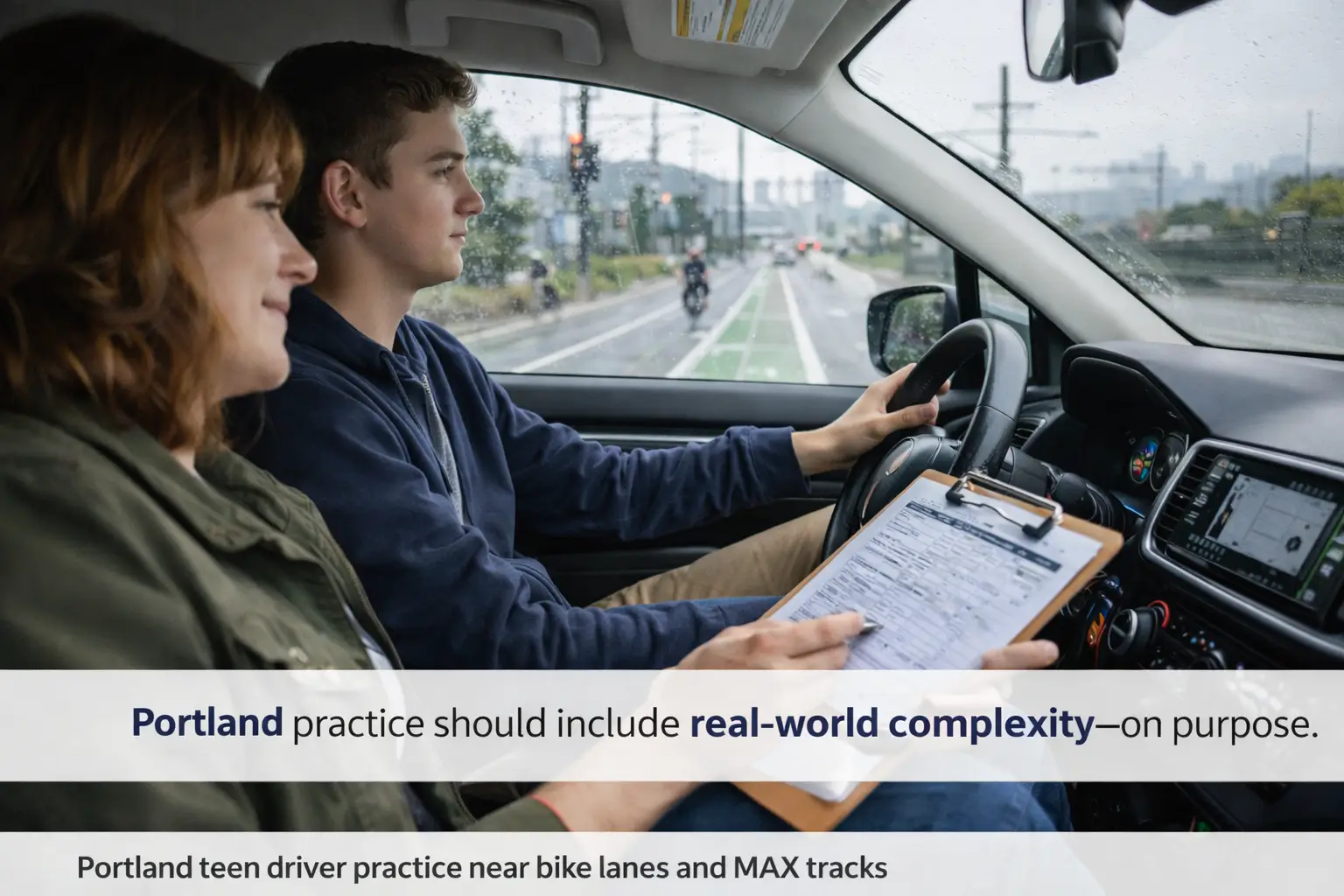
Portland-area teens need practice that reflects real driving—bike lanes, buses, rail crossings, rain glare, and tight lanes. The key is progressive difficulty: start simple, then add complexity intentionally. This is how you make the next teen driver test feel familiar.
Portland practice should include real-world complexity—on purpose.
Route type #1: Neighborhood basics
Use calm residential streets to train stops, scanning, and speed anchors. This is where you build the habit foundation that carries into the teen driver test.
Route type #2: Bike-lane awareness routes
Practice scanning for cyclists early, shoulder checks before turning, and patience near lane shifts. This trains awareness and reduces “surprise moments” during the teen driver test.
Route type #3: Arterial roads (safe timing only)
Add arterial roads only after basics are stable. Train speed consistency, lane choice early, and calm merges—skills that show up on any teen driver test.
Costly mistakes families repeat after a teen driver test
Most families don’t fail because they “don’t care.” They fail because their practice approach creates stress or trains the wrong thing. Here are the most common mistakes after a teen driver test—and what to do instead.
One win + one focus after each drive keeps progress moving.
Mistake #1: Practicing too long
A 2-hour marathon drive often ends with frustration. Short, focused sessions build more skill for the next teen driver test.
Mistake #2: Correcting constantly
When a parent talks nonstop, the teen’s brain can’t build independence. A quiet driver with one focus improves faster—and performs better on the teen driver test.
Mistake #3: Training too many skills at once
Pick 1–2 habits per week. If the teen is improving those habits, the next teen driver test is already trending upward.
Once basics are stable, you must add real-world complexity on purpose. That’s what makes a teen driver test feel “normal.”
When one targeted lesson saves weeks of teen driver test stress
If the same issue repeats twice (blind spots, lane drift, speed floating, rushed gaps), one targeted lesson can be the fastest fix. A pro instructor can correct a technique problem in minutes that families struggle to coach for weeks—making the next teen driver test much smoother.
One targeted lesson can replace 10 frustrating practice sessions.
Want a calm plan for the next teen driver test?
We help Portland-area teens build safe habits that hold up under pressure—rain, traffic, bike lanes, and all. If your teen needs targeted help after a teen driver test, we’ll point you to the fastest path forward.
Whether your path is waiver-based or DMV-based, the habits that improve a teen driver test outcome are the same: scanning, full stops, speed consistency, lane discipline, and calm decisions.
FAQ about the teen driver test
How soon should we practice again after a teen driver test?
Within 48 hours is ideal—short and low stress. Momentum matters, but pressure doesn’t. Keep it calm so the next teen driver test feels predictable.
What should we practice the most for the teen driver test?
Observation habits, complete stops, speed consistency, lane discipline, and calm decision timing. Those five categories are the biggest levers for most families after a teen driver test.
How do I coach without fighting?
One focus per drive. Coach only safety-critical moments. Debrief with “one win + one focus.” This protects confidence—and confidence is performance on the teen driver test.
Should we book a pro lesson before the next teen driver test?
If the same issue repeats twice, yes. A targeted lesson often saves weeks of frustration and makes the next teen driver test far less stressful.